Having access to your money is an important part of everyday life. Everyone should be able to purchase goods in a way that is easy, safe and secure for them.
Handling Cash
To find your nearest branch and the location of cash machines you have the right to ask your bank to give you information in your preferred format.
If you’re withdrawing cash from the branch, you can ask the cashier to count your money out by denomination. You might also want to ask the cashier to count out the notes and coins separately and for money and receipts be placed directly into your hand.
Talking ATMs are becoming more common. These machines allow users to insert headphones and listen to instructions instead of having to read text on a screen. It will give you several choices and ask you to press the appropriate option on the keypad. The ‘five’ has a raised dot which enables you to navigate the numbers. Talk to your bank to see if this is an option.
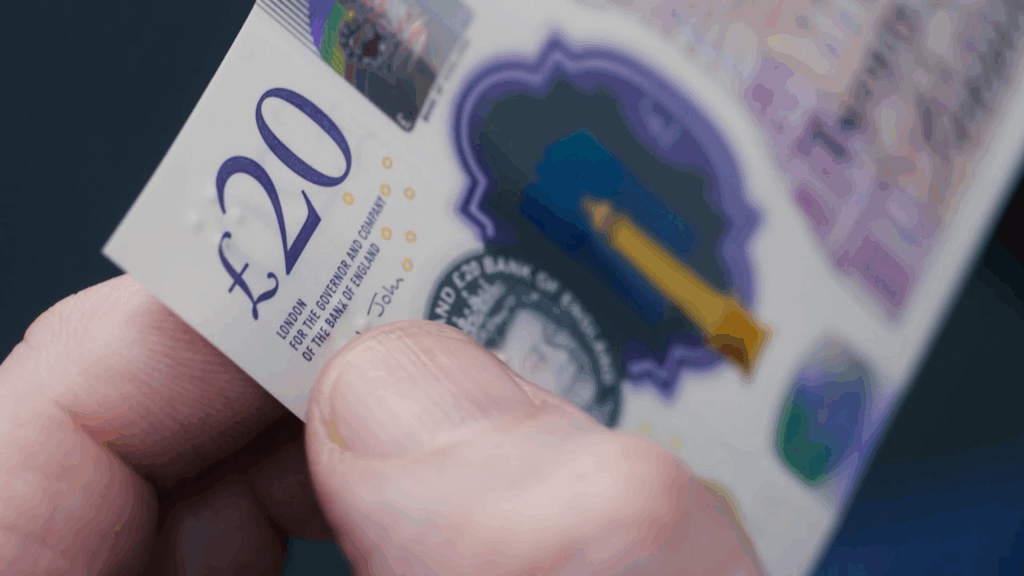
Once you receive your cash, you can use the tactile dots to help identify notes. On bank notes created after February 2020 you should be able to feel a series raised dots in the top left-hand corner. The £10 note has four raised dots in a square, repeated once below (two squares in total). The £20 note has three squares. The £50 note has four squares. The £5 note is distinguishable by the absence of the tactile feature. However, you need to be careful if you have larger denominations as there are not currently any tactile markings on larger notes.
The 10 pence piece has a milled edge to it to help to identify it from a 2 pence piece.
Paying by Card
If you prefer to pay by card you can often easily pay in shops through contactless payments. A contactless purchase of up to £100 can be made by simply tapping your card on the card reader. However, you will sometimes be asked to enter your PIN for security reasons. Most keypads will have the same layout in shops. The number ‘5’ will have a tactile marking and the “enter” key is usually a larger button in the bottom right-hand corner. There may be times when you’ll be asked to use a touchscreen pad. A separate high-contrast option can be selected before the keypad appears. The shop assistant should be able to help with this. Retailers are expected to have accessible payment systems as part of the Equality Act.
If using a keypad is difficult then you can ask for a chip and signature card from your bank instead. Many banks offer the option for a tactile slot on the side of the card to know which way up to insert it into a card reader. Shops should accept chip and signature cards as a reasonable adjustment to make their service accessible to you.
If you are comfortable with technology, there is also the option of Google and Apple pay, which can get set up on your smart phone with your smart phone accessibility settings. This allows you to pay with your smart phone or smart watch.
Please be aware that scams are rife during the holiday season. If you’re ever unsure about a payment, or are feeling pressured, stop and call your bank directly.
If you have any questions or or want to talk through your concerns you can call Vision Norfolk at 01603 573000 or email [email protected] to learn how we can help support you.